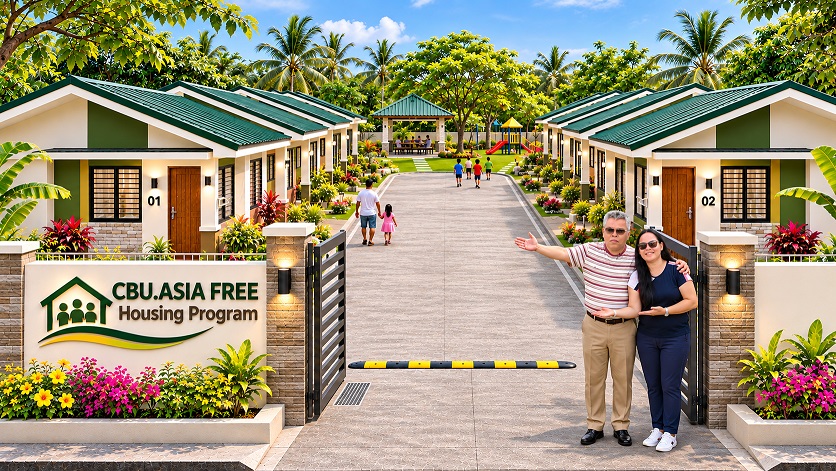
CBU.ASIA FREE HOUSING PROGRAM
Program Mechanics, Eligibility Requirements, and Beneficiary Guidelines
Program Theme:
Building Homes. Building Families. Building Faith. Building a Better Future.
I. PROGRAM PURPOSE
The CBU.ASIA FREE Housing Program is a social responsibility, worker welfare, and family development initiative established to help qualified workers achieve greater housing security and provide a stable home for their families.
The program recognizes that a home is more than a roof over one’s head. It is the foundation upon which a family builds its future.
Through this initiative, CBU.ASIA intends to provide qualified worker families with access to decent housing while encouraging responsible employment, family development, community participation, and continued Catholic faith formation.
II. PROGRAM IMPLEMENTATION AND PHASES
Phase 1 – Initial Housing Allocation
For the initial implementation, CBU.ASIA intends to provide ten (10) housing units, subject to the available project budget, land, and development capacity.
All applicants who satisfy the eligibility requirements may participate in a transparent public raffle.
Ten (10) qualified couples will be selected as Phase 1 beneficiaries.
The raffle will be conducted openly, with appropriate witnesses and documentation to promote fairness and transparency.
Phase 2 – Confirmed Future Beneficiaries
Qualified couples who participate in the Phase 1 raffle but are not selected among the ten initial winners will automatically become confirmed Phase 2 beneficiaries.
They will not be required to participate in another raffle to establish their Phase 2 priority.
CBU.ASIA shall maintain an official registry of these qualified non-winning applicants and carry their beneficiary status forward for the next phase of the program.
Each qualified Phase 2 beneficiary should receive a written certificate or acknowledgment confirming their status and priority under the program.
The Phase 2 commitment is subject to the availability of land, funds, construction resources, and the company’s capacity to proceed with additional housing units. CBU.ASIA shall communicate the implementation schedule and any material changes to registered beneficiaries.
III. ELIGIBILITY REQUIREMENTS
To qualify, applicants must meet all of the following conditions:
- Applicants must be a legally married couple.
- At least one spouse must have been working for CBU.ASIA or a designated participating construction operation for a minimum of six (6) months at the time of application.
- The qualifying worker must be in good working standing, subject to reasonable company assessment and applicable work policies.
- Neither spouse must have previously received a house under this particular housing program.
- The couple must agree to comply with the program’s housing, work, community, and family-development requirements.
- Both spouses must agree to participate in continuing Catholic catechism and faith-formation activities organized through the program.
- Only one application may be submitted per married couple.
Both newly married workers and workers who were already married before joining CBU.ASIA may apply, provided they satisfy the requirements.
IV. CATHOLIC MARRIAGE REQUIREMENT
The program recognizes couples whose marriages were celebrated through the Catholic Church as well as couples whose marriages were initially solemnized through a civil ceremony.
A. Couples Already Married Through the Catholic Church
Couples who were married through the Catholic Church before joining CBU.ASIA may qualify by submitting a valid Catholic Marriage Certificate issued or recognized by the Church.
B. Couples Married Through a Civil Ceremony
Couples whose marriage was solemnized only through a civil ceremony, such as a ceremony conducted by a judge, mayor, or other authorized public official, may still participate in the program.
However, they must agree to undergo and successfully complete the CBU.ASIA Free Catholic Wedding Program, culminating in the celebration of their Catholic wedding, in order to satisfy this requirement.
A signed commitment or agreement to participate is required during application. However, merely signing the commitment does not mean the Catholic marriage requirement has already been fulfilled. The couple must complete the required Catholic wedding process.
C. Couples Who Have Completed the CBU.ASIA Free Catholic Wedding Program
Couples who have successfully completed the CBU.ASIA Free Catholic Wedding Program automatically satisfy this particular marriage requirement, subject to submission of the appropriate documentation.
V. APPLICATION DOCUMENTS
Applicants must submit the following documents:
- Completed and signed CBU.ASIA Free Housing Program application form.
- Valid marriage certificate.
- Catholic Marriage Certificate, when applicable.
- For civil-only marriages, a signed commitment to complete the CBU.ASIA Free Catholic Wedding Program, or proof of successful completion if already completed.
- Certificate of Work or Employment from CBU.ASIA or the designated participating operation.
- Proof that the qualifying worker has completed at least six (6) months of work.
- Valid identification documents of both spouses.
- Signed acknowledgment of the program mechanics, conditions, and responsibilities.
- Signed commitment to participate in continuing Catholic catechism and family-formation activities.
CBU.ASIA may request reasonable additional documents when necessary to verify eligibility.
VI. RAFFLE AND SELECTION PROCESS
The initial ten (10) Phase 1 beneficiaries shall be selected through a public raffle among all qualified applicants.
The process shall follow these guidelines:
- Every qualified couple shall be assigned a unique raffle number.
- The raffle shall be conducted openly and witnessed by designated representatives or independent witnesses.
- Ten (10) winning couples shall be selected for the initial housing allocation.
- The raffle proceedings shall be documented through photographs, video recordings, and an official written record.
- The names of the winners shall be announced and recorded.
- All qualified non-winning applicants shall automatically be registered as confirmed Phase 2 beneficiaries.
If a selected winner becomes disqualified or voluntarily withdraws before occupying the assigned unit, CBU.ASIA may offer the available unit to an eligible reserve applicant in accordance with documented selection procedures.
VII. HOUSING BENEFIT AND OCCUPANCY CONDITIONS
Qualified Phase 1 beneficiaries shall be provided with free housing occupancy while they continue to satisfy the applicable work conditions and comply with the program agreement.
During the qualifying period:
- No monthly mortgage or rent payment shall be required from the beneficiary.
- The housing subsidy shall be provided as a worker welfare benefit under the terms of the program.
- The beneficiary must use the house as the family’s principal residence.
- The beneficiary must maintain the property and observe the community rules.
The free housing benefit does not automatically transfer ownership of the house or land to the beneficiary.
Ownership, title, occupancy rights, restrictions, and any eventual transfer of ownership shall be governed by a separate written agreement between CBU.ASIA and the beneficiary, consistent with applicable Philippine laws.
VIII. UTILITIES, MAINTENANCE, AND OTHER HOUSEHOLD EXPENSES
Although qualifying beneficiaries are not required to pay monthly rent or mortgage while receiving the free housing subsidy, they remain responsible for their own household consumption and applicable community expenses.
These may include:
- Electricity consumption.
- Water consumption.
- Utility connection or service charges, as applicable.
- Security and community maintenance contributions.
- Garbage collection and disposal.
- Shared plumbing, drainage, and wastewater system maintenance.
- Repairs required because of damage, misuse, negligence, or unauthorized alterations caused by the beneficiary or household members.
CBU.ASIA shall maintain transparent records of any shared community contributions and explain the basis of the charges to beneficiaries.
IX. WORK-LINKED HOUSING SUBSIDY
A. Continued Work with CBU.ASIA
The free housing subsidy is linked to the beneficiary’s continued qualifying work with CBU.ASIA or a designated participating operation, subject to the written program agreement.
As long as the applicable work conditions remain satisfied, the beneficiary may continue enjoying free housing occupancy without monthly mortgage or rent payments.
B. Voluntary Resignation or Transfer to Another Employer
If the qualifying worker voluntarily resigns from CBU.ASIA or leaves to work for another company, including another construction company, the free housing subsidy may cease in accordance with the written agreement and applicable law.
The beneficiary may continue occupying the same house under the affordable monthly payment arrangement described in this document, subject to the individual housing agreement.
C. Termination or Other Work Separation
If the working relationship ends for any other reason, the housing benefit shall be reviewed according to the circumstances, the written housing agreement, and applicable Philippine labor and housing laws.
The end of the working relationship shall not automatically authorize eviction or immediate removal of the beneficiary’s family.
Cases involving dismissal, redundancy, retrenchment, illness, disability, company-initiated separation, or disputed termination must be handled fairly and in accordance with applicable law and the beneficiary’s written agreement.
D. Return to CBU.ASIA Work
A former beneficiary who later returns to qualifying work with CBU.ASIA may be considered for reinstatement of the free housing subsidy, subject to management approval, work status, and a written agreement.
X. MONTHLY HOUSING PAYMENT AFTER THE FREE SUBSIDY ENDS
When the free housing subsidy ceases under the applicable program conditions, the beneficiary may continue occupying the same house under an affordable monthly housing payment arrangement.
The monthly payment shall be calculated at:
10% of the combined monthly household income.
A. What Counts as Combined Household Income?
For this program, combined household income includes the regular income of:
- The husband;
- The wife; and
- Their adult children who are employed or earn regular income and continue living in the same housing unit with their parents.
The income of adult children who no longer live in the household shall not be included.
Children who are still studying and do not have regular income shall not be included.
Income shall be considered regardless of the employer or source of regular employment income.
B. Sample Computation
| Household Member | Monthly Income |
|---|---|
| Husband | ₱15,000 |
| Wife | ₱10,000 |
| Employed adult child living at home | ₱8,000 |
| Employed adult child living at home | ₱7,000 |
| Combined household income | ₱40,000 |
Monthly housing payment:
₱40,000 × 10% = ₱4,000 per month
Therefore, the monthly housing payment for this example would be ₱4,000.
C. Income Verification and Reassessment
CBU.ASIA may periodically review the household’s combined income to ensure that the monthly housing payment remains consistent with the program’s formula.
Reasonable supporting documents may include:
- Payslips;
- Certificates of Employment;
- Other proof of regular income; and
- A household income declaration.
The monthly payment may be recalculated when there are significant changes in household income, such as a new work arrangement, resignation, retirement, or a working adult child moving out of the home.
The income information of adult children shall be obtained with their knowledge and consent. Their income being included in the household computation does not automatically make them personally liable for their parents’ housing obligation.
For consistent administration, the individual housing agreement shall specify whether income is measured before or after mandatory deductions. The recommended basis is net monthly income after mandatory statutory deductions.
XI. TEMPORARY UNEMPLOYMENT AND PAYMENT SUSPENSION
CBU.ASIA recognizes that families may experience temporary unemployment, financial difficulty, or unexpected loss of income.
If all qualifying income-earning household members become unemployed and the household has no qualifying regular income, the beneficiary may request a temporary suspension of monthly housing payments.
For this purpose, qualifying household members include the husband, wife, and employed adult children who live in the same housing unit and whose income is included in the household computation.
The following conditions shall apply:
- The beneficiary must notify CBU.ASIA of the household’s unemployment situation.
- Reasonable supporting documents may be requested to verify the loss of work or income.
- During an approved suspension, no monthly housing payment shall be required.
- No additional interest or penalty shall accrue solely because of the approved payment suspension.
- Once one or more qualifying household members regain regular work or income, the monthly payment shall be reassessed using the applicable 10% household-income formula.
- If some qualifying household members remain working, their combined qualifying income shall be used in calculating the monthly payment.
The purpose of this provision is to prevent temporary unemployment from immediately placing a beneficiary family at risk of losing its home.
The process for requesting, approving, reviewing, and ending a payment suspension shall be specified in the individual housing agreement.
XII. CONTINUING CATHOLIC CATECHISM AND FAMILY FORMATION
The CBU.ASIA Free Housing Program includes continuing Catholic catechism and family-formation activities as part of its guiding values.
Beneficiary couples agree to participate in reasonable activities organized by CBU.ASIA, which may include:
- Catholic catechism and faith-formation sessions.
- Marriage and family-life discussions.
- Christian values and responsibilities in family life.
- Prayer gatherings and appropriate religious activities.
- Family development and community-building activities.
Schedules should be reasonably flexible to accommodate work, illness, family responsibilities, and other legitimate circumstances.
Participation requirements shall be explained clearly before enrollment. They shall be administered with respect for the dignity, conscience, and lawful rights of workers and their families. The program’s religious provisions should be reviewed by qualified legal counsel to ensure compliance with applicable Philippine laws.
XIII. HOUSE AND COMMUNITY RULES
To protect the housing development and promote a safe, orderly, and harmonious neighborhood, all beneficiaries shall agree to the following rules:
- The housing unit shall be used as the family’s principal residence.
- The house shall not be rented out, subleased, or occupied by unrelated persons for commercial purposes without written approval from CBU.ASIA.
- Beneficiaries shall keep their homes and immediate surroundings clean and sanitary.
- Structural changes, extensions, and major alterations shall require prior written approval.
- Beneficiaries shall respect their neighbors and avoid activities that create unreasonable disturbance.
- Shared roads, walkways, drainage systems, open spaces, and community facilities shall be maintained and used responsibly.
- Illegal, dangerous, or threatening activities shall not be permitted within the development.
- Beneficiaries shall not sell, transfer, assign, or pledge their program-related housing rights while such rights remain restricted under the agreement.
- All residents shall observe reasonable security, sanitation, maintenance, and community guidelines.
- Beneficiaries shall cooperate in preserving the safety and cleanliness of the entire housing development.
XIV. WITHDRAWAL, DISQUALIFICATION, AND BENEFICIARY STATUS
Before occupancy, an applicant or selected winner may be disqualified or withdrawn from the program for reasons including:
- Submission of fraudulent or materially misleading information;
- Failure to satisfy the eligibility requirements;
- Voluntary withdrawal from the program;
- Refusal to sign the required program acknowledgment or housing agreement; or
- Failure to comply with essential pre-occupancy requirements.
Any disqualification shall be documented, and the affected applicant shall be informed of the reason.
Qualified non-winning Phase 1 applicants shall retain their confirmed Phase 2 beneficiary status, subject to the program’s eligibility requirements and the conditions governing future implementation.
After occupancy, any change, suspension, or termination of housing rights shall be governed by the individual housing agreement and applicable law. No beneficiary shall be deprived of legally protected rights through an automatic or arbitrary process.
XV. PROGRAM ADMINISTRATION AND MANAGEMENT
CBU.ASIA shall designate a program committee or authorized representatives to oversee implementation.
The committee’s responsibilities may include:
- Receiving and reviewing applications.
- Verifying eligibility and supporting documents.
- Organizing and documenting the public raffle.
- Maintaining the official Phase 1 and Phase 2 beneficiary registry.
- Coordinating housing allocation and occupancy.
- Monitoring compliance with the housing agreement.
- Reviewing household income declarations and monthly payment arrangements.
- Processing requests for temporary unemployment payment suspension.
- Coordinating catechism and family-formation activities.
- Maintaining records of maintenance contributions and shared expenses.
- Addressing beneficiary concerns and community disputes.
- Providing program updates and reports to management.
All important decisions affecting beneficiary status, payment obligations, and housing rights should be properly documented.
XVI. FUTURE EXPANSION
The CBU.ASIA FREE Housing Program is envisioned as a continuing initiative that may expand as the company’s resources and capacity permit.
Future phases may provide additional housing units to qualified workers and registered Phase 2 beneficiaries.
The timing and number of additional units shall depend on available land, funding, construction costs, project development requirements, and the company’s financial capacity.
CBU.ASIA shall endeavor to honor the priority of confirmed Phase 2 beneficiaries while communicating realistic implementation plans and any material changes.
XVII. GUIDING PRINCIPLE
The CBU.ASIA FREE Housing Program is founded on the belief that a stable home can strengthen families, encourage responsible work, and create a more hopeful future.
It is not simply a housing initiative. It is an investment in people, families, and the community they build together.
A home is more than a roof over one’s head. It is the foundation upon which a family builds its future.
CBU.ASIA – Building Homes. Building Families. Building Faith. Building a Better Future.