
The Philippines is getting hotter, and homeowners are paying attention. Discover how ICF insulated homes and energy-efficient tropical design can improve indoor comfort, reduce unwanted heat gain, and potentially lower cooling demand.
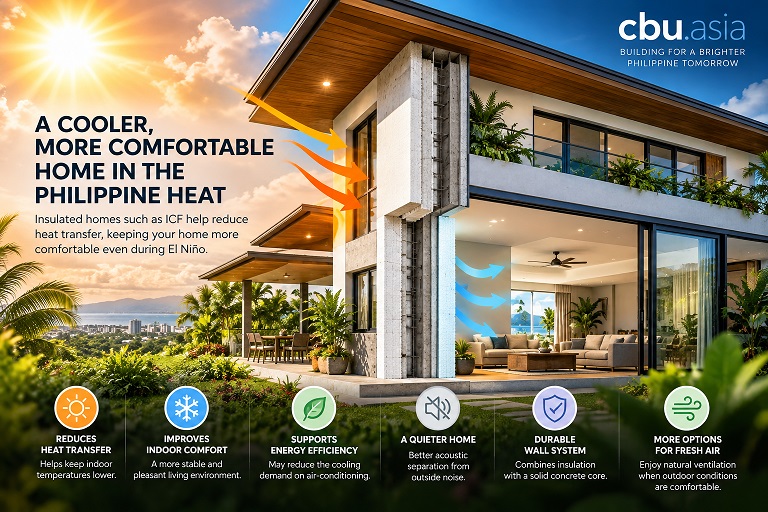
As the Philippines experiences periods of intense heat associated with El Niño, homeowners are asking an increasingly important question: How can we keep a house cool without depending entirely on air-conditioning?
For many homeowners, particularly those building in Cebu, Mactan, Bohol, Negros, and other parts of the Visayas, the answer begins with the building envelope. A well-designed insulated home can slow the movement of outdoor heat into the interior, helping maintain a more comfortable indoor environment and allowing air-conditioning systems to work under less demanding conditions.
One of the most advanced approaches is Insulated Concrete Form construction, commonly known as ICF.
What Is an ICF Insulated Home?
ICF, or Insulated Concrete Forms, is a construction system that uses insulating forms to create reinforced concrete walls. The insulating forms remain part of the completed wall, creating a combination of structural strength, thermal insulation, and mass.
Unlike a conventional concrete wall where insulation may be added later, ICF incorporates insulation directly into the wall assembly. This creates a continuous insulated barrier around much of the building’s exterior.
For tropical Philippine conditions, this can be particularly valuable because the building is constantly exposed to solar heat and high outdoor temperatures.
Why Insulation Matters During El Niño
El Niño is a climate phenomenon associated with abnormal warming of the tropical Pacific Ocean. Its effects vary from place to place, but in the Philippines, El Niño can contribute to periods of below-normal rainfall and increased heat.
During prolonged sunny periods, roofs, exterior walls, windows, and other building surfaces can absorb significant amounts of solar energy. Some of that heat eventually moves into the interior.
A poorly insulated home may therefore become increasingly uncomfortable during the afternoon, forcing occupants to run air-conditioning for longer periods.
An insulated home takes a different approach.
Instead of allowing heat to move easily from the outside environment into the living space, the building envelope is designed to slow down heat transfer.
That does not mean an ICF house will never become hot. No building material can eliminate the effects of a tropical climate. However, properly designed insulation can reduce unwanted heat gain and contribute to more stable indoor conditions.
Less Heat Coming In Can Mean Less Work for the Air Conditioner
Air-conditioning is extremely useful in the Philippines, particularly during hot and humid weather. But an air conditioner has to remove the heat that enters the house.
The more heat entering a building, the harder the cooling system has to work.
This is why energy-efficient home design should begin before the air conditioner is installed.
An insulated wall system can reduce heat transfer through exterior walls. Roof insulation can reduce heat entering through the roof. Exterior shading can reduce solar radiation through windows. Efficient glazing can further control unwanted solar heat gain.
When these elements work together, the air-conditioning system may have a smaller cooling load than it would in a poorly designed building.
Actual energy savings will depend on many factors, including house size, insulation levels, window area, orientation, roof design, occupancy, air-conditioning efficiency, thermostat settings, and local weather conditions. Nevertheless, reducing unwanted heat gain is a fundamental principle of energy-efficient building design.
ICF Is More Than Just Insulation
One reason ICF is attractive for premium homes is that it combines several functions in one wall system.
The reinforced concrete core provides structural mass, while the insulating forms provide thermal insulation. The resulting wall can also contribute to acoustic performance and durability.
For homeowners building a permanent residence, retirement home, vacation property, or high-end custom home, this combination can be particularly attractive.
Instead of thinking about the house as simply a collection of concrete walls, doors, windows, and finishes, ICF allows the building envelope to become an important part of the home’s overall performance.
A Cooler Home Begins With the Roof
Homeowners sometimes focus heavily on wall insulation while overlooking one of the biggest sources of solar heat: the roof.
In a tropical climate, the roof can receive intense solar radiation throughout the day. A properly designed insulated roof or ceiling assembly can therefore be an essential component of a comfortable home.
At CBU, we believe the best approach is not to rely on one material alone. The entire house should be considered as a thermal system.
That can include insulated walls, roof insulation, reflective roofing materials, properly positioned windows, exterior shading, appropriate glazing, airtight construction, efficient inverter air-conditioning, and controlled ventilation.
Windows Can Make or Break a Tropical Home
A highly insulated wall cannot compensate for excessive solar heat entering through large, unshaded windows.
This is particularly important in modern homes with large glass walls and expansive windows.
Window orientation, glazing selection, overhangs, canopies, vertical fins, curtains, blinds, and landscaping can all influence how much solar heat reaches the interior.
A beautiful home can still be uncomfortable if its windows are poorly positioned for the Philippine sun.
This is why thermal performance should be considered during the architectural design stage rather than after construction has already begun.
What About Prefabricated Insulated Walls?
Not every homeowner needs a complete ICF house.
For projects where ICF is not the preferred structural system, properly designed prefabricated insulated wall systems can provide another way to improve the thermal performance of a building.
This can be especially attractive for homeowners who want improved insulation while retaining more conventional construction methods.
The objective remains the same: create a building envelope that provides better resistance to unwanted heat transfer.
For CBU, this means giving clients more than one pathway toward an insulated tropical home, depending on their budget, structural requirements, architectural design, and performance goals.
Better Comfort Beyond El Niño
Perhaps the most important point is that homeowners should not think about insulation only as an El Niño solution.
El Niño eventually ends.
The Philippines, however, will continue to experience a warm and humid tropical climate.
A properly insulated home can therefore provide benefits during ordinary years as well as during unusually hot periods.
The goal is not simply to survive one extreme season. The goal is to create a home that remains comfortable and efficient for many years.
Insulation Can Also Improve Acoustic Comfort
ICF construction offers another benefit that is particularly attractive in urban and developed areas: noise control.
The combination of substantial concrete mass and insulated wall construction can help reduce the transmission of outside noise compared with many lightweight wall assemblies.
For homes near busy roads, commercial areas, neighborhoods, or other sources of outdoor noise, a quieter interior can make a significant difference in everyday comfort.
A Better Strategy for Building in Cebu and the Visayas
For homeowners building in Cebu, Mactan, Bohol, Negros, Siquijor, Camotes, and other parts of the Visayas, the ideal house should be designed for the environment in which it will actually operate.
That means thinking about heat, humidity, solar exposure, rainfall, ventilation, noise, energy consumption, and long-term durability.
The answer is not necessarily to make every house completely dependent on mechanical cooling.
Instead, the house itself should help manage the environment.
Keep the heat outside. Control the sun. Insulate the walls and roof. Use efficient windows. Ventilate intelligently. Then use air-conditioning when it is actually needed.
This approach can be particularly attractive to expats, retirees, OFWs, and Filipino families building their long-term homes in the Philippines. These homeowners are often looking beyond the initial construction price and thinking about comfort, durability, operating costs, and the quality of life the house will provide for decades.
Build for the Philippine Climate
The current El Niño period is a reminder that Philippine homes must be designed for heat as well as rain and storms.
An ICF insulated home is not a magic solution, and insulation does not eliminate the need for air-conditioning in a hot, humid climate. But when combined with good architectural design and efficient mechanical systems, it can form an important part of a high-performance tropical home.
At CBU — Custom Builders Union, our approach is to design and build homes around the needs of the Philippine climate.
Whether you are considering an ICF insulated home, a prefabricated insulated wall system, or a conventional structure enhanced with modern thermal insulation, we can help develop a building approach suited to your property, lifestyle, and budget.
Ready to Build a Cooler, More Comfortable Home in the Philippines?
Don’t wait until the next extreme heat period to think about insulation.
If you are planning a new home in Cebu, Mactan, Bohol, Negros, Siquijor, Camotes, or elsewhere in the Visayas, consider thermal performance from the very beginning of the design process.
Build better. Insulate smarter. Stay comfortable.
CBU — Custom Builders Union
ICF & Insulated Tropical Home Design and Construction
Design your home for the Philippine climate — not against it.