
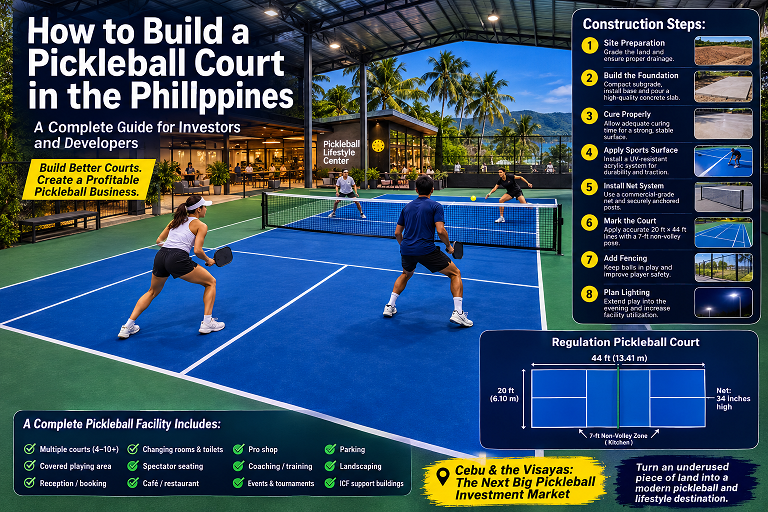
Pickleball is rapidly becoming one of the most popular recreational sports in the Philippines, creating a new construction opportunity for property owners, entrepreneurs, resorts, hotels, subdivisions and sports facility developers.
But building a good pickleball court involves much more than pouring concrete and painting lines.
A properly designed court needs the right dimensions, foundation, drainage, surface, fencing, lighting and, in the Philippine climate, careful consideration of heat, rain, humidity and tropical weather.
For investors considering a pickleball business, the opportunity can go even further. Instead of constructing a single court, a property can be developed into a complete pickleball and lifestyle facility combining courts, food and beverage, events, coaching, retail and other amenities.
Here’s what you need to know before building.
What Are the Standard Pickleball Court Dimensions?
A regulation pickleball court measures:
- 20 feet (6.10 meters) wide
- 44 feet (13.41 meters) long
- 7-foot non-volley zone (“kitchen”) at each end
- A net approximately 34 inches high at the center
However, the playing area is only part of the space required for a successful facility.
A commercial pickleball development needs additional room around the courts for player movement, fencing, walkways, spectators, equipment, drainage and access.
This is why a developer should never calculate land requirements simply by multiplying 20 feet by 44 feet for every court.
The total site requirement can be substantially larger.
Step 1: Choose and Prepare the Site
The first stage of construction is selecting suitable land.
A good pickleball site should have:
- Adequate access
- Sufficient parking potential
- Good drainage
- Reliable electricity and water
- Suitable soil conditions
- Enough room for future expansion
- Appropriate zoning and permitting
- Reasonable proximity to the target market
For commercial facilities, accessibility is particularly important.
A beautiful property with poor road access may be less commercially attractive than a slightly smaller site that is easy for customers to reach.
Drainage Is Critical in the Philippines
One of the biggest mistakes in outdoor court construction is treating drainage as an afterthought.
The Philippines receives substantial rainfall, and heavy tropical downpours can quickly expose deficiencies in site grading and drainage.
The court and surrounding property should therefore be designed as an integrated system.
Depending on the site, this can include:
- Proper finished-floor elevations
- Surface grading
- Perimeter drains
- Catch basins
- Stormwater collection
- Proper discharge arrangements
- Appropriate sub-base preparation
The objective is simple:
Rainwater should leave the playing area quickly and predictably.
Step 2: Build the Court Foundation
A pickleball court requires a stable, properly prepared foundation.
A typical construction sequence is:
Site excavation
↓
Subgrade preparation and compaction
↓
Granular base
↓
Reinforcement and formwork
↓
Concrete slab
↓
Proper curing
↓
Sports surface system
The precise slab thickness, reinforcement and sub-base requirements should be determined by the project engineer based on soil conditions, drainage, expected loads and the intended use of the facility.
A private recreational court and a busy commercial facility should not automatically receive the same structural specification.
Don’t Treat the Court Like a Driveway
A common mistake is approaching pickleball court construction as if it were simply another concrete slab.
The surface needs to be sufficiently flat and consistent for sports use.
Poor workmanship can result in:
- Uneven playing conditions
- Water pooling
- Premature cracking
- Surface deterioration
- Poor ball bounce
- Player safety concerns
For a commercial facility, investing in proper engineering and construction quality at the beginning can save considerable expense later.
Step 3: Allow the Concrete to Cure Properly
Concrete needs adequate time and proper conditions to cure before the sports surfacing system is installed.
Rushing this stage can create problems with the finished surface.
Before applying the coating system, the contractor should ensure that the concrete is suitable for the manufacturer’s specified surface preparation and installation requirements.
The objective is to create a stable foundation for the layers that follow.
Step 4: Install the Sports Surface
Players shouldn’t normally be playing directly on unfinished concrete.
A purpose-designed outdoor sports surface can provide better traction, consistency and durability.
A typical acrylic sports surface system may incorporate:
- Primer or bonding layer
- Crack treatment where required
- Acrylic resurfacing material
- Color coats
- Textured finish
- Court line markings
The exact system should be selected according to the manufacturer’s specifications and the intended application.
Choose for the Philippine Climate
For outdoor courts in Cebu and other tropical locations, the surface should be selected with consideration for:
- UV exposure
- High temperatures
- Heavy rainfall
- Humidity
- Repeated wet/dry cycles
- Frequent commercial use
A quality sports surface is an important part of the overall investment.
Step 5: Install the Net System
The net is one of the most visible components of the court, but it also needs to be properly installed.
For a permanent commercial facility, a durable commercial-grade net and post system is generally preferable to inexpensive temporary equipment.
The posts should be securely anchored and positioned according to the court design.
Accuracy matters.
Even a well-built court can look and play poorly if the net and court markings aren’t correctly aligned.
Step 6: Mark the Court Accurately
Once the surface has been prepared, the court lines can be applied.
The standard playing area is:
20 feet × 44 feet
with the 7-foot non-volley zone at each end.
Accurate measurement is essential.
Court markings should be straight, consistent and compatible with the selected sports-surface system.
Professional line-marking equipment and proper layout procedures can make a significant difference in the finished appearance.
Step 7: Install Fencing and Ball-Stop Systems
Outdoor pickleball facilities can benefit greatly from appropriate fencing.
Fencing can:
- Keep balls within the facility
- Improve player safety
- Define entrances and exits
- Protect surrounding property
- Provide security
- Create opportunities for branding and advertising
Depending on the site, additional ball-stop netting may be appropriate.
For commercial developments, fencing should be considered during the initial site design rather than added as an afterthought.
Step 8: Plan Proper Court Lighting
Lighting can significantly increase the commercial value of a pickleball facility.
Without lighting, court utilization is largely restricted to daylight hours.
With properly designed lighting, the facility can potentially operate:
Morning → Afternoon → Evening
This is particularly important for customers who work during the day.
A professional lighting design should address:
- Adequate illumination
- Uniformity
- Glare
- Shadows
- Light spill
- Pole positioning
- Electrical requirements
- Structural wind loads
Lighting poles and their foundations should be properly engineered for the local environment.
Should You Build Covered Pickleball Courts?
For the Philippines, this is one of the most important questions a developer should consider.
A covered facility can provide significant advantages.
Instead of exposing the courts directly to the tropical sun and rain, a developer can construct a large roof structure over the playing area.
A typical concept might look like:
Large roof structure
↓
Open or partially enclosed sides
↓
Multiple pickleball courts
This can help protect the facility from:
- Heavy rainfall
- Direct sunlight
- Extreme heat
- Weather-related cancellations
- Premature surface deterioration
It can also provide a substantially better customer experience.
Don’t Forget the Roof Height
Pickleball involves a significant amount of vertical ball movement.
A covered facility therefore needs sufficient unobstructed overhead clearance.
The structural design should account for the actual playing environment rather than simply providing enough height for people to stand underneath the roof.
The roof structure, columns, lighting and other elements should be positioned so they don’t interfere with normal play.
Open-Air or Covered?
There isn’t one answer for every project.
Open-air courts
Advantages can include:
- Lower initial construction cost
- Simpler structure
- Natural ventilation
- Easier expansion
Covered courts
Advantages can include:
- Protection from rain
- Reduced direct solar exposure
- More predictable operating hours
- Better player comfort
- Greater potential utilization
- More opportunities for evening play
For a serious commercial facility in a tropical climate, a covered design deserves careful consideration.
Don’t Build Just a Court—Build a Pickleball Business
This is where the opportunity becomes much more interesting for investors.
A single court is a sports facility.
A 4-, 6-, 8- or 10-court development can become a business.
Instead of thinking:
“I want to build pickleball courts.”
Think:
“I want to build a pickleball and lifestyle destination.”
The development could potentially combine:
- Multiple pickleball courts
- Covered playing areas
- Reception and registration
- Changing rooms
- Toilets and showers
- Spectator seating
- Café or restaurant
- Pro shop
- Coaching facilities
- Tournament facilities
- Event areas
- Storage
- Parking
- Landscaping
- Offices
- Staff facilities
This creates multiple potential sources of revenue rather than relying exclusively on court rental.
Who Could Build a Pickleball Facility?
The potential market isn’t limited to professional sports operators.
Possible developers include:
Landowners
Owners of vacant or underutilized land can investigate whether a pickleball facility could provide a better use for their property.
Entrepreneurs
An entrepreneur can develop a dedicated sports and entertainment business.
Resort Owners
Resorts can incorporate pickleball as an additional recreational attraction.
A resort could potentially offer pickleball alongside:
- Swimming
- Dining
- Wellness
- Accommodation
- Other recreational activities
Hotels
Hotels can use pickleball as an amenity that gives guests another reason to stay longer.
Subdivision Developers
Pickleball courts can become part of the amenities offered by residential developments.
Condominium Developers
In higher-density developments, pickleball can provide a relatively compact recreational amenity compared with larger sports facilities.
Existing Sports Facilities
Gyms, tennis facilities and other sports businesses may have opportunities to convert or expand underutilized areas.
Pickleball and Tourism
The opportunity becomes particularly interesting in tourism destinations.
Imagine a development that combines:
Pickleball + Resort + Restaurant + Villas
or:
Pickleball + Wellness + Accommodation + Events
This could appeal to local players as well as tourists, retirees, expatriates and visiting sports enthusiasts.
For locations such as Cebu, Bohol, Siquijor and other tourism-oriented areas of the Visayas, the concept can potentially be adapted to the character of the destination.
An Opportunity for ICF and Insulated Construction
The pickleball court itself does not necessarily require ICF construction.
However, ICF can be particularly interesting for the support buildings associated with a larger development.
For example:
Pickleball courts
ICF reception building
ICF café
ICF changing rooms
ICF offices
ICF accommodation or villas
This creates a broader construction opportunity.
Insulated construction can be considered for enclosed areas where thermal comfort, durability and reduced heat transfer are important.
In a tropical environment, the objective isn’t simply to build a strong structure.
It is to create a facility that people actually enjoy spending time in.
Design for Expansion From the Beginning
Another important consideration is future growth.
A developer may initially build four courts and later discover that demand supports six, eight or more.
If expansion is possible, the original site plan should consider:
- Future court locations
- Electrical capacity
- Drainage
- Parking
- Structural expansion
- Plumbing
- Reception capacity
- Additional amenities
Planning for expansion during the initial design stage can be considerably easier than trying to fit additional facilities onto a fully developed site later.
Professional Design and Engineering Matter
A commercial pickleball facility is more than a sports surface.
It is a construction project involving:
- Site development
- Structural engineering
- Concrete construction
- Drainage
- Electrical systems
- Lighting
- Roofing
- Plumbing
- Fire and life safety
- Accessibility
- Permits
- Landscaping
- Parking
- Business operations
Local building regulations and permitting requirements should be addressed before construction begins.
A qualified architect and engineers should be involved in the design, particularly for larger facilities and covered structures.
How Much Land Do You Need?
The answer depends heavily on the number of courts and the supporting facilities.
A single court occupies only about 814 square feet (75.6 square meters) of playing area.
But that is not the same as the land required to build a usable facility.
Once you add:
- Safety clearances
- Space between courts
- Walkways
- Fencing
- Reception
- Toilets
- Parking
- Landscaping
- Equipment areas
- Food and beverage
- Future expansion
the total site requirement becomes considerably larger.
This is why commercial projects should begin with a master site plan, rather than simply drawing courts onto an available piece of land.
The Bottom Line
Pickleball court construction can be relatively simple for a private recreational court.
But a commercial pickleball facility is an entirely different proposition.
The successful project should bring together:
Good site selection
Proper drainage
A correctly engineered foundation
A quality sports surface
Accurate court layout
Professional lighting
Appropriate fencing
Adequate overhead clearance
Weather protection where appropriate
Comfortable supporting facilities
A strong business concept
The biggest opportunity may not be in building a single pickleball court.
It may be in helping landowners and investors transform underutilized property into modern pickleball and lifestyle destinations.
For developers in Cebu and throughout the Visayas, this emerging market deserves serious consideration.
Have land and wondering what you could build on it?
A well-planned pickleball facility could potentially turn an underutilized property into a destination for sport, recreation, dining, events and community.