From repairing earthquake damage to replacing an old pastoral building, a parish can turn a major building need into a well-planned capital fundraising campaign.
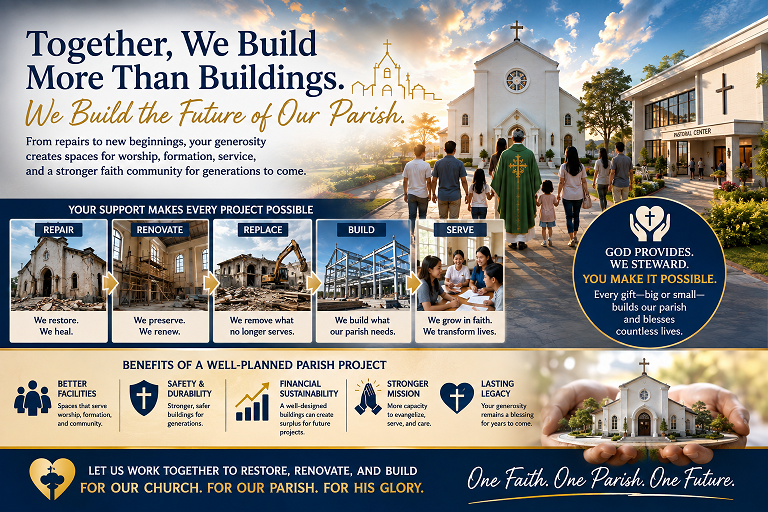
Every parish eventually faces a major building project.
Sometimes the need is urgent.
An earthquake may have damaged the church.
A roof may have deteriorated.
Structural cracks may have appeared.
An old building may no longer be safe or functional.
Electrical and plumbing systems may be outdated.
A parish hall may have become too small.
Or an aging pastoral office may have reached the point where demolishing and replacing it makes more sense than continuing to repair it.
And sometimes the parish simply needs more space.
A new pastoral center, ministry building, catechetical center, parish hall or formation facility may be necessary to serve a growing community.
The common problem is obvious:
Where will the parish find the money?
For a major project, ordinary Sunday collections may not be enough.
The answer may be to develop a parish capital fundraising campaign specifically for the project.
And when properly planned, a major capital project can potentially do more than solve an immediate building problem.
It can strengthen the parish’s facilities, improve its ability to serve its community, and potentially create financial capacity for future parish projects.
Don’t Think of It as “A Construction Project”
One of the biggest mistakes a parish can make is to think about a major building need only as a construction problem.
For example:
“Our church needs ₱20 million worth of repairs.”
That statement immediately creates a difficult question:
Where will we get ₱20 million?
Instead, think of the project as a capital development campaign.
The process becomes:
Identify the need
↓
Determine the best solution
↓
Establish the cost
↓
Develop the fundraising story
↓
Identify major benefactors
↓
Launch the campaign
↓
Construct or repair in phases
↓
Report the results
↓
Build the parish’s capacity for the next project
That is a completely different approach.
There Are Many Types of Parish Capital Projects
A parish doesn’t necessarily have to be raising money for an entirely new church.
Major fundraising campaigns can potentially be developed for many different needs.
1. Earthquake or Disaster Rehabilitation
For churches damaged by earthquakes, typhoons, fires or other disasters, the priority is to restore the building safely and appropriately.
The campaign can fund:
- structural assessment;
- structural strengthening;
- reconstruction;
- roof replacement;
- masonry repairs;
- electrical rehabilitation;
- plumbing;
- waterproofing;
- interior restoration;
- accessibility improvements;
- and other necessary works.
The first step should always be a proper assessment by qualified professionals.
A fundraising campaign should be based on a realistic scope of work—not an arbitrary number.
2. Major Church Repairs
A church doesn’t have to be severely damaged before a capital campaign becomes appropriate.
Major projects may include:
- roof replacement;
- structural repairs;
- foundation work;
- façade restoration;
- repainting;
- flooring;
- ceiling replacement;
- electrical upgrades;
- plumbing;
- drainage;
- air-conditioning;
- lighting;
- sound systems;
- fire-safety improvements;
- accessibility improvements;
- and restoration of deteriorated elements.
Instead of allowing deterioration to continue until an emergency occurs, a parish can develop a Church Preservation and Rehabilitation Campaign.
3. Demolition and Replacement of an Old Pastoral Building
This can be one of the most interesting opportunities for a parish.
Many parishes have old structures that were built decades ago.
They may have:
- outdated layouts;
- inadequate offices;
- deteriorated roofing;
- obsolete plumbing;
- inefficient electrical systems;
- insufficient meeting rooms;
- poor accessibility;
- structural deterioration;
- or simply not enough space for today’s ministries.
At some point, continually repairing an old building may no longer make economic or functional sense.
The better solution may be:
Demolish → Replace → Modernize
The old structure can make way for a properly planned pastoral center designed around the parish’s current and future needs.
This can provide:
- parish offices;
- meeting rooms;
- catechism classrooms;
- youth facilities;
- counseling rooms;
- ministry offices;
- formation rooms;
- conference space;
- parish organization facilities;
- storage;
- and multipurpose spaces.
The result isn’t simply a new building.
It is a modern pastoral infrastructure for the parish’s future.
4. Building a New Pastoral Center on Existing Parish Property
A parish may also have an appropriate portion of its existing compound that can potentially accommodate a new facility, subject to property, zoning, diocesan, heritage, safety and other applicable requirements.
This means the fundraising challenge may not involve acquiring land at all.
The parish may already possess the most important real-estate component of the project.
The question becomes:
How can the parish make the best pastoral and financial use of the property it already has?
A professional development study can examine:
- available space;
- existing buildings;
- circulation;
- parking;
- utilities;
- access;
- drainage;
- zoning;
- future expansion;
- and the parish’s long-term pastoral requirements.
5. Parish Hall and Multipurpose Facilities
A parish may need a new hall for:
- parish meetings;
- formation programs;
- catechism;
- youth activities;
- community gatherings;
- retreats;
- conferences;
- charitable activities;
- ministry training;
- and other parish functions.
A multipurpose facility can potentially serve many ministries rather than being designed for only one purpose.
That can make the fundraising story much stronger:
One building. Many ministries. Thousands of parishioners served over many years.
6. Catechetical and Formation Buildings
Faith formation is one of the central activities of a parish.
A parish may therefore raise funds specifically for:
A Parish Formation Center
with facilities for:
- catechism;
- Bible studies;
- RCIA or equivalent formation programs where applicable;
- marriage preparation;
- youth formation;
- retreats;
- adult faith formation;
- seminars;
- ministry training;
- and parish leadership development.
This gives donors a very clear answer to the question:
“What will my donation accomplish?”
The Most Important Principle: Don’t Start With the Fundraising Target
A parish should not begin with:
“We need ₱30 million.”
Begin with:
“What exactly do we need?”
Then determine:
What is the problem?
What is the best solution?
What should the finished project look like?
What will it cost?
What can be done in phases?
Only then should the parish establish the fundraising target.
That produces a much more credible campaign.
Turn the Building Into a Story
Major donors rarely become excited by a construction quotation.
They become interested in impact.
Instead of:
“The pastoral building will cost ₱25 million.”
Tell the donor:
“This building will provide the parish with classrooms for catechism, meeting rooms for its ministries, counseling facilities, offices for parish administration, and a formation hall that can serve parishioners for decades.”
The building becomes a means to accomplish something.
The project is the building.
The story is the mission.
The Major Benefactor Strategy
For a large project, one of the most powerful fundraising tools can be a major-benefactor campaign.
The parish identifies people who may have the ability and willingness to make substantial contributions.
These could include:
- successful parishioners;
- business owners;
- professionals;
- former parishioners;
- overseas Filipinos;
- families with longstanding connections to the parish;
- corporations;
- foundations;
- alumni;
- and friends of the parish.
Instead of waiting for thousands of small donations to accumulate, the parish can seek a number of lead gifts that establish momentum.
For example:
Founding Benefactor
₱2,000,000+
Legacy Benefactor
₱1,000,000+
Major Benefactor
₱500,000+
Pastoral Partner
₱250,000+
Building Patron
₱100,000+
The actual levels should be appropriate to the project and parish community.
The purpose is not to pressure wealthy people.
It is to give those who genuinely want to make a significant contribution an opportunity to become part of the project’s history.
Ask for a Specific Impact
A major donor is more likely to respond to a specific opportunity than a vague request.
Instead of:
“Can you donate ₱1 million?”
the parish could present:
“Would your family consider helping fund the Parish Formation Hall?”
or:
“Would you consider becoming one of the Founding Benefactors of the new Pastoral Center?”
or:
“Would your family consider helping us restore this damaged section of the church?”
The donor should be able to see:
The problem → the solution → the cost → the impact.
Build a Benefactor Program
A major capital campaign can also establish an appropriate Founding Benefactors or Legacy Benefactors program, subject to parish and diocesan approval.
Possible elements include:
Prayer and Mass remembrance
The parish can appropriately remember benefactors and their families in its prayers and Mass intentions according to its actual practices.
Annual Mass of Thanksgiving
A special annual Mass can recognize and thank the families who supported the project.
Benefactor recognition
Appropriate recognition may include:
- a benefactors’ book;
- commemorative plaques;
- donor recognition;
- a donor wall;
- recognition at groundbreaking;
- recognition at dedication;
- or sponsorship of appropriate facilities.
Pastoral engagement
The parish may also provide benefactors with a designated contact to help coordinate ordinary pastoral needs and appointments, consistent with parish policies and the principle that sacraments are not purchased through donations.
The purpose should be:
gratitude + pastoral relationship + spiritual fellowship
rather than the appearance of selling privileged access.
Don’t Forget the Ordinary Parishioner
Major donors can provide the foundation of a capital campaign, but ordinary parishioners should also have an opportunity to participate.
A campaign can have several levels:
Major Benefactors
↓
Family Sponsors
↓
Parish Organizations
↓
Small Donors
↓
Children and Youth
↓
Prayer and volunteer supporters
Someone who can give ₱5,000 should be able to feel that they helped build the same building as someone who gave ₱2 million.
The project belongs to the entire parish.
Create Multiple Ways to Give
Make contributing simple.
Depending on what is authorized and available to the parish, donors may be able to contribute through:
- bank transfer;
- check;
- online payment;
- GCash or other approved digital channels;
- recurring donations;
- corporate donations;
- in-kind materials;
- professional services;
- or direct sponsorship of specific project components.
The easier it is to understand how to give, the less likely a potential donor is to postpone the decision.
In-Kind Donations Can Be Extremely Valuable
Not every contribution needs to be cash.
A donor may be able to provide:
- cement;
- steel;
- roofing materials;
- electrical equipment;
- furniture;
- air-conditioning;
- lighting;
- professional services;
- landscaping;
- transportation;
- equipment;
- or construction services.
A parish may therefore have:
Cash fundraising + material donations + professional donations + volunteer assistance.
This can potentially reduce the amount of cash that must be raised.
All such arrangements should be properly documented and accepted according to the parish’s applicable policies and approvals.
Build the Project in Phases
One of the most effective ways to make a large project seem achievable is to divide it into phases.
Instead of:
“We need ₱30 million.”
the campaign might become:
Phase 1
Structural rehabilitation — ₱8M
Phase 2
Roof and building envelope — ₱5M
Phase 3
Electrical and plumbing — ₱4M
Phase 4
Interior works — ₱6M
Phase 5
Furniture and equipment — ₱3M
Now the parish can say:
“Our immediate goal is to raise ₱8 million for Phase 1.”
Once Phase 1 is completed, donors can see tangible results.
That creates confidence for Phase 2.
Show Donors Their Money Is Working
Fundraising doesn’t end when the check is deposited.
It becomes even more important afterward.
Provide:
- photographs;
- construction updates;
- fundraising totals;
- project milestones;
- expenditure reports;
- donor acknowledgments;
- videos;
- and completion updates.
If donors can see the project progressing, they are much more likely to believe that their generosity is producing something real.
Trust is one of the most valuable assets in a capital campaign.
Catholic fundraising principles likewise emphasize defined needs, truthful appeals, proper use of donated funds, honoring donor restrictions, and accountability.
What Happens When the Project Costs Less Than Expected?
This is an important part of capital-project planning.
Suppose a parish launches a campaign based on a realistic project budget.
During construction, the parish receives:
- donated materials;
- discounted materials;
- donated professional services;
- competitive construction bids;
- value-engineering savings;
- or other legitimate cost reductions.
The project may ultimately cost less than the amount raised.
What happens to the difference?
This should never be improvised after the fundraising campaign begins.
The parish should establish appropriate policies and communicate clearly with donors about the intended use of funds.
Under canon law, offerings given for a specific purpose are to be applied to that purpose, and Church administrators have obligations concerning proper accounting, donor/founder intentions and stewardship.
Where permitted by the fundraising terms, donor restrictions, parish policy and diocesan approvals, an excess can potentially become a capital reserve for future parish projects.
That can be tremendously valuable.
A New Pastoral Building Can Potentially Help Fund Future Projects
This is where a well-designed pastoral building can become more than an expense.
A properly planned facility may potentially:
- reduce the parish’s operating costs;
- consolidate scattered offices;
- provide multipurpose facilities;
- support approved community activities;
- provide appropriate rental/event space;
- and generate legitimate income that can be directed toward future parish needs.
The objective is not to turn the parish into a commercial real-estate business.
The objective is:
Build a facility that serves the parish’s mission while being financially responsible.
If the facility generates legitimate surplus after its operating costs and obligations, that surplus can potentially contribute to future projects, subject to parish and diocesan policies.
This creates a powerful long-term concept:
Today’s capital project can help make tomorrow’s capital project possible.
Sometimes the Best Building Project Is Replacement, Not Repair
An old building can create a difficult decision.
Should the parish spend another ₱2 million repairing it?
Or should it spend ₱15 million replacing it?
The correct answer depends on the building’s:
- structural condition;
- remaining useful life;
- functionality;
- maintenance requirements;
- space efficiency;
- operating cost;
- future needs;
- and replacement cost.
A professional assessment can compare:
OPTION A
Continue repairing
versus
OPTION B
Demolish and replace
versus
OPTION C
Renovate and expand
The cheapest immediate option is not necessarily the cheapest long-term option.
A proper capital-development analysis should consider the total long-term value of each alternative.
The Parish Already Has an Asset
In many parish situations, the biggest advantage is that the parish already controls its existing church compound or facilities.
That means the project may not require acquiring a new property.
Instead, the opportunity may be to:
repair an existing building
or
renovate an existing building
or
replace an obsolete structure
or
develop an appropriate underused portion of the parish property.
This can dramatically change the economics of the project.
The parish’s existing property becomes part of the capital-development equation.
A Professional Fundraising Campaign Starts Before Construction
Before approaching major donors, prepare:
The Project Brief
What are we building or repairing?
The Need
Why is the project necessary?
The Vision
What will the completed facility accomplish?
The Budget
How much will it cost?
The Phases
What can be built first?
The Timeline
How long will it take?
The Funding Plan
Where will the money come from?
The Benefactor Program
How will major supporters participate?
The Accountability Plan
How will funds and construction progress be reported?
Now the parish isn’t approaching donors with:
“Father says we need money.”
It is approaching them with:
“Here is a professionally developed project that we believe will significantly strengthen our parish’s mission.”
That is a much more compelling proposition.
From Damaged Church to New Pastoral Center
The same capital-development approach can be used for very different parish needs.
EARTHQUAKE DAMAGE
Assess → Fund → Stabilize → Repair → Restore
AGING CHURCH
Assess → Preserve → Renovate → Upgrade
DETERIORATED PASTORAL BUILDING
Assess → Compare repair vs. replacement → Fund → Demolish → Rebuild
INADEQUATE FACILITIES
Assess needs → Design → Fund → Build
GROWING PARISH
Master plan → Phase → Fund → Build → Expand
The project changes.
The fundraising system remains fundamentally the same.
The Parish Capital Development Model
A parish can think of its major building needs as a continuing cycle:
1. IDENTIFY
What does the parish need?
↓
2. ASSESS
What is the best technical solution?
↓
3. PLAN
What should the project look like?
↓
4. COST
What will it realistically cost?
↓
5. FUND
Who can help make it possible?
↓
6. BUILD
Construct or repair in controlled phases.
↓
7. REPORT
Show donors and parishioners what was accomplished.
↓
8. SUSTAIN
Maintain the facility and responsibly manage any legitimate financial benefits.
↓
9. REPEAT
Use the experience and, where permitted, financial capacity to address the parish’s next major need.
This Is Where a Professional Parish Project Consultant Can Help
Many priests and pastoral councils are experts in pastoral ministry.
They are not necessarily experts in:
- construction;
- engineering;
- cost estimation;
- capital campaigns;
- major-donor solicitation;
- project phasing;
- procurement;
- construction management;
- financial modeling;
- or donor communications.
They shouldn’t have to become construction professionals just because their parish needs a building.
A professional project-development partner can help bring those capabilities together.
The role can begin long before construction.
It can include:
Project Assessment
Understanding the parish’s building problem.
Project Development
Determining whether to repair, renovate, replace or build.
Preliminary Cost Planning
Establishing a realistic project budget.
Fundraising Strategy
Creating a capital campaign and major-benefactor strategy.
Donor Presentation
Showing potential benefactors what their generosity can accomplish.
Project Phasing
Breaking a large project into achievable stages.
Construction Management
Coordinating the project once it is authorized and funded.
Construction
Where appropriate and subject to the parish’s and diocese’s procurement and approval requirements, serving as contractor for the actual construction.
Your Parish Doesn’t Have to Wait Until the Building Is Falling Apart
The best time to think about a major parish building project is not necessarily after a crisis.
It can be when the parish recognizes:
“This building is no longer adequate for our mission.”
Perhaps the roof is approaching the end of its useful life.
Perhaps the pastoral office is too small.
Perhaps the parish hall is overcrowded.
Perhaps the church has suffered earthquake damage.
Perhaps the old building is becoming more expensive to maintain every year.
Perhaps the parish needs facilities for a growing population.
These are not merely construction problems.
They are capital-planning opportunities.
Let’s Turn Your Parish’s Building Need Into a Fundable Project
Whether your parish needs to:
Repair earthquake damage
Restore an aging church
Renovate an existing facility
Demolish and replace a deteriorated building
Build a new pastoral center
Expand parish facilities
Construct a formation or ministry center
or
Develop a long-term parish facilities master plan
the first step does not have to be finding the money.
The first step is developing a credible project that people will want to support.
Once the parish can clearly explain:
what it needs → why it matters → what it will cost → what it will accomplish → how it will be built
the fundraising conversation becomes much easier.
Don’t Just Ask People to Donate to a Building.
Invite Them to Help Build the Future of Their Parish.
If your parish has a major repair, restoration, replacement or new-building need, we can help you explore the project from:
Assessment → Planning → Costing → Fundraising → Benefactor Engagement → Project Development → Construction
The first conversation does not have to be about signing a construction contract.
It can simply begin with one question: