Cebu remains one of the Philippines’ most attractive tourism destinations, but today’s resort investment opportunity is about much more than simply building a few cottages beside the beach.
For investors considering a resort development in Cebu, one of the most important questions is:
“How much should I invest, and what kind of resort can that investment create?”
The answer depends on the location, land acquisition cost, property size, construction standards, number of rooms, amenities and target market.
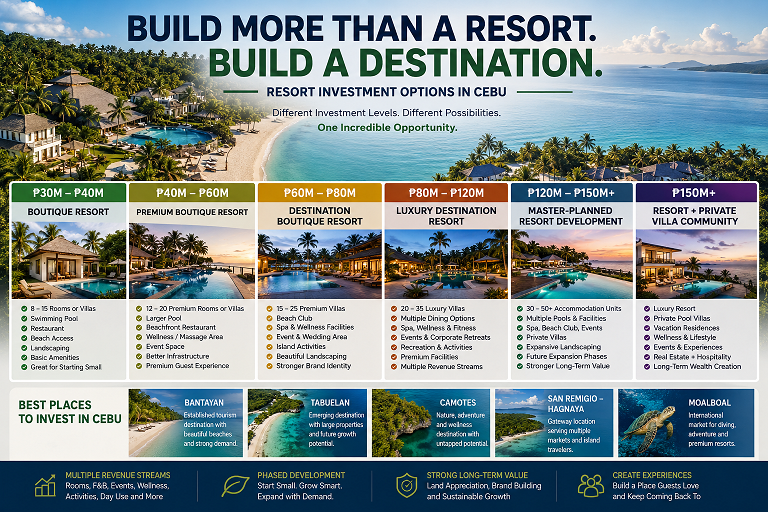
A ₱30 million project can potentially create an attractive boutique resort.
A ₱50 million investment can move into a much more premium concept.
At ₱70 million and above, investors can begin thinking about a true destination resort.
And at ₱100 million to ₱150 million or more, the project can potentially become a master-planned resort and vacation-property development.
The important thing is to choose the location and concept according to the investment level rather than simply trying to build as many rooms as possible.
The Key Principle: Build an Experience, Not Just Rooms
The traditional resort model is relatively simple:
Rooms + swimming pool + restaurant + beach.
But competition is increasing.
A more interesting strategy is to create a property where the resort itself becomes part of the destination.
Guests should have a reason to choose your property instead of simply choosing the cheapest available accommodation.
That could mean:
- Premium villas
- Exceptional architecture
- Tropical landscaping
- Large swimming pools
- Beach clubs
- Wellness facilities
- Restaurants and sunset dining
- Private experiences
- Island-hopping
- Diving and water activities
- Events and weddings
- Family recreation
- Long-stay accommodation
- Private vacation villas
The higher the investment, the more opportunities there are to create multiple revenue streams.
What Can You Build at Different Investment Levels?
₱30 Million–₱40 Million
Boutique Resort
At this level, the goal should be quality over quantity.
Rather than trying to build a large hotel, an investor could consider a compact boutique resort with approximately:
8–15 rooms or villas
combined with:
- Swimming pool
- Small restaurant
- Beach facilities
- Reception
- Landscaping
- Parking
- Basic recreation
- Quality interiors
The resort could target:
couples, families, weekend travelers and foreign visitors.
This investment level can work particularly well in an emerging destination where land costs are still relatively manageable.
The strategy:
Start small, establish the brand and leave room for expansion.
A ₱30M resort should ideally not be designed as a finished project with nowhere to grow.
₱40 Million–₱60 Million
Premium Boutique Resort
Moving toward ₱50 million opens up considerably more possibilities.
An investor could consider approximately:
12–20 premium rooms or villas
with:
- Larger swimming pool
- Beachfront restaurant
- Premium landscaping
- Better guest facilities
- Wellness or massage area
- Event space
- Children’s facilities
- Better infrastructure
- Solar/backup power
- High-quality furnishings
- Strong internet connectivity
This is where the resort can begin targeting a more affluent domestic and international market.
Instead of competing primarily on price, the property can compete on:
comfort + design + experience + service.
₱60 Million–₱80 Million
Destination Boutique Resort
At this level, the project can become much more ambitious.
Imagine:
15–25 premium villas
plus:
- Large resort pool
- Beach club
- Restaurant and bar
- Spa/wellness facilities
- Event and wedding area
- Tropical gardens
- Children’s recreation
- Water activities
- Island tours
- Premium infrastructure
- Staff facilities
- Backup utilities
- High-quality architecture
Now the resort begins to function as a destination in itself.
Guests aren’t simply visiting the area and looking for somewhere to sleep.
They are choosing the resort because they want the experience.
₱80 Million–₱120 Million
Luxury Destination Resort
This investment level opens the door to a substantially larger development.
Depending on land costs and construction specifications, an investor could consider:
20–35 luxury villas or accommodation units
combined with several major amenities.
For example:
Accommodation
Luxury villas and suites.
Food & Beverage
Restaurant, bar, beachfront dining and private dining.
Wellness
Spa, massage, yoga and wellness programs.
Recreation
Swimming pools, beach activities, kayaking, cycling and excursions.
Events
Wedding venue, corporate retreat facilities and private events.
Guest Experience
Sunset decks, gardens, lounges and curated island experiences.
The resort begins to resemble a full destination property rather than a conventional beach hotel.
₱120 Million–₱150 Million+
Master-Planned Resort Development
At this level, investors should start thinking beyond the first construction phase.
The project can potentially be master-planned as a larger destination development containing:
30–50+ accommodation units
plus:
- Multiple pools
- Premium restaurant
- Beach club
- Spa and wellness center
- Event facilities
- Recreation
- Private villas
- Landscaped gardens
- Staff facilities
- Expanded infrastructure
- Dedicated activity areas
Most importantly, the property can be designed with future phases in mind.
The initial investment doesn’t have to represent the final size of the development.
₱150 Million+
Resort + Private Villa Community
At the upper end of the investment spectrum, the concept can move beyond hospitality.
It can become:
A Resort and Vacation Home Community
The development could combine:
Luxury resort accommodation
- private pool villas
- vacation residences
- restaurant and beach club
- wellness
- events
- recreation
- long-term rental opportunities.
Some private villas could potentially be sold, while others remain part of the rental pool.
This creates a potentially powerful combination of:
hospitality + real estate + tourism.
Don’t Automatically Spend More on More Rooms
One of the biggest mistakes a resort investor can make is assuming:
More money = more rooms.
That isn’t necessarily true.
A better approach can be:
More money = better experience + better location + better facilities + stronger brand + greater expansion potential.
For example, 20 exceptional villas can potentially be more attractive than 50 ordinary rooms.
A premium guest may spend more on:
- Accommodation
- Food
- Drinks
- Spa
- Activities
- Tours
- Events
The objective is therefore not simply to maximize room count.
It is to maximize the value of each guest and the attractiveness of the entire property.
Where in Cebu Could These Resorts Be Built?
Different locations make sense for different investment strategies.
Bantayan
Best suited for:
Premium and upscale island resorts
Bantayan already has a strong tourism identity and is particularly attractive for investors looking for an established destination.
The opportunity is to create a resort that stands out through:
design + service + privacy + food + experiences.
Tabuelan
Best suited for:
Emerging luxury and boutique destination resorts
Tabuelan is particularly interesting for investors who want to get ahead of heavier development.
A larger property could potentially be acquired and developed in phases.
The strategy could be:
Phase 1 → Boutique resort
Phase 2 → More villas
Phase 3 → Private pool villas
Phase 4 → Wellness and events
Phase 5 → Vacation residences
This makes Tabuelan particularly interesting for investors with a long-term development vision.
Camotes
Best suited for:
Nature, wellness and destination resorts
Camotes lends itself to a resort concept centered around:
nature + wellness + beaches + adventure + relaxation.
Rather than competing solely on beach access, a developer can create a complete island experience.
This is particularly suitable for larger properties and long-term development strategies.
San Remigio–Hagnaya
Best suited for:
Family resorts and Northern Cebu gateway developments
This area can potentially serve several markets:
- Cebu weekend travelers
- Families
- Beach vacationers
- Foreign visitors
- Events
- Long-stay guests
- Travelers heading toward Bantayan
A sufficiently large property could potentially become both a destination and a gateway.
Moalboal
Best suited for:
International adventure and diving resorts
Moalboal already has a strong tourism identity.
For a new investor, the challenge is differentiation.
A new resort should therefore offer something beyond simply providing accommodation.
A strong concept could combine:
premium villas + diving + wellness + food + private experiences.
The Real Opportunity: Develop in Phases
One of the most attractive strategies for investors is phased development.
You don’t necessarily have to build the ultimate resort on day one.
Instead:
Phase 1
Build the first group of villas and core facilities.
Phase 2
Add additional accommodation.
Phase 3
Add premium pool villas.
Phase 4
Add spa, wellness and events.
Phase 5
Add private vacation residences.
This reduces the need to commit the entire long-term development cost immediately.
More importantly, the first phase provides an opportunity to prove the market before committing to later phases.
Think About the Final Property From Day One
If you are buying a large coastal property, don’t design only the buildings you can afford today.
Design the master plan for the property you want to own 10 or 20 years from now.
For example:
Today
₱50M resort.
Tomorrow
₱100M resort.
Eventually
₱150M+ destination development.
The initial construction establishes:
the brand + the infrastructure + the guest experience.
Future phases build on that foundation.
Multiple Revenue Streams Make the Resort Stronger
A resort should not necessarily depend entirely on room bookings.
A well-planned property can potentially generate revenue from:
Accommodation
Rooms, suites and villas.
Food & Beverage
Restaurant, bar, beach club and private dining.
Events
Weddings, birthdays, corporate retreats and celebrations.
Wellness
Spa, massage, yoga and wellness programs.
Activities
Island hopping, diving, kayaking, cycling and excursions.
Day Use
Pool, beach and recreation facilities.
Long-Stay Guests
Monthly and seasonal accommodation.
Private Villas
Vacation rentals or potential villa sales.
This can transform the resort from a simple accommodation business into a multi-revenue tourism property.
ICF Construction Can Add Another Dimension
For developers who specialize in ICF and insulated construction, a resort can also become a real-world demonstration property.
Imagine guests staying inside villas designed with:
- Highly insulated walls
- Insulated roofs
- Quality windows
- Reduced heat transfer
- Efficient air-conditioning
- Quiet interiors
- Durable construction
Instead of telling potential clients about the benefits of insulated construction, they can experience the difference themselves.
The resort can therefore serve two purposes:
Tourism business
and
Construction showcase.
A guest could arrive for a vacation and eventually become interested in building:
a retirement home, vacation home, rental villa or private resort.
That creates a unique opportunity for developers who combine hospitality and construction.
What Should Investors Look for in the Land?
Regardless of the investment level, the land may be the most important part of the project.
Look for:
Excellent beach quality
Not simply a property described as “beachfront.”
Good accessibility
Guests should be able to reach the resort comfortably.
Utilities
Reliable electricity and water.
Internet
Strong connectivity for modern travelers and long-stay guests.
Expansion potential
Enough land for future phases.
Environmental suitability
Professional evaluation of flooding, erosion, drainage, storm exposure and other coastal conditions.
Legal security
Title, zoning, access rights, coastal restrictions and required permits should all be properly investigated.
Which Investment Level Is Right for You?
There is no single “correct” amount to invest.
Instead, consider what you want to create.
₱30M–₱40M
Boutique resort
Best for investors who want a smaller initial project with expansion potential.
₱40M–₱60M
Premium boutique resort
More villas, better amenities and a stronger premium-market position.
₱60M–₱80M
Destination boutique resort
A property substantial enough to become an attraction in itself.
₱80M–₱120M
Luxury destination resort
Multiple revenue streams, extensive amenities and a stronger resort brand.
₱120M–₱150M+
Master-planned resort development
Large-scale hospitality with room for additional villas, facilities and future phases.
₱150M+
Resort + vacation property community
A combination of hospitality, private residences, tourism and real estate.
The Most Important Decision Isn’t the Budget
It is tempting to begin with:
“I have ₱50 million. What can I build?”
A better approach is:
“What kind of destination do I want to create, and which Cebu location gives me the best chance of making it successful?”
Then determine the appropriate investment.
The right property might justify ₱30M.
Another might justify ₱70M.
A truly exceptional coastal property could justify ₱150M or more.
The budget should follow the opportunity, not the other way around.
Cebu’s Next Resort Opportunities May Be Outside the Obvious Places
Bantayan, Moalboal and other established tourism destinations will continue to attract investors.
But some of the most interesting opportunities may be found in locations where tourism is still developing.
Tabuelan.
San Remigio.
Camotes.
And other coastal areas where a well-designed resort could become one of the attractions that puts the location on the tourism map.
For investors with the vision and capital to develop a property properly, that can be considerably more exciting than simply buying into an already crowded market.
The Bigger Vision
Imagine starting with a carefully selected beachfront property.
At ₱30M, it could become a boutique resort.
At ₱50M, it could become a premium villa resort.
At ₱70M–₱100M, it could become a destination resort.
At ₱150M+, it could evolve into a resort, wellness destination and private vacation-home community.
The investment doesn’t have to stop at the first phase.
The land, master plan and brand can become the foundation for something much larger.
Cebu doesn’t need more ordinary beach resorts.
It needs well-planned destinations that give people a reason to travel, stay longer, spend more and come back.
For investors considering entering the Philippine tourism market, the opportunity is not simply to build another resort.
The opportunity is to build a destination.
And the right investment level can determine just how ambitious that destination can become.